
A Complete Guide to Pharma Bottle Packaging Machine Selection
A Complete Guide to Pharma Bottle Packaging Machine Selection

I keep seeing the same mistake. A factory owner asks for a filling machine quote, gets three or four prices, picks the middle one, pays the deposit, and then finds out the quote was for the filler only. The unscrambler, capper, labeler, coding unit, and conveyors are all extra. Worse, modules from different makers often don’t connect cleanly, so the line stops every few minutes while someone carries bottles across the gap.
This guide is for the person who has to run the line and explain the purchase to the boss. It covers what the system really includes, how to size it, how to match it to your product, what GMP really asks for, honest price ranges, layout, and the questions that separate a real supplier from a catalog seller. If this is your first bottle packaging line, don’t ask for a quote before you finish reading.
What Parts Does a Pharma Bottle Packaging Line Actually Include?
Don’t think of a “filling machine” as one box. Think of a chain of stations. Each module hands a bottle to the next one, and the whole line can only run as fast as its weakest station.
The line usually starts with an automatic bottle unscrambler. It takes bottles out of bulk and lines them up on the conveyor at a steady rhythm. Skip it, and one worker does nothing but feed bottles all day. That quietly kills the labor savings you thought automation would bring.
Then comes the filler, which is the heart of the line. After that, the capper closes the bottle, and a torque station tightens every cap to the same feel. Next, the labeler puts the label on straight, and the coder stamps batch number, lot, and expiry date on every unit. Many buyers also add a weight inspector or a vision inspection machine here. Catching an underfilled bottle inside the plant is far cheaper than catching it after shipment.
One thing people forget: conveyors, hopper, and guard frames are part of the purchase too. A real bottle packaging line proposal should list every module, its power, its footprint, and its connection to the next station. When you compare quotes, put this list side by side. A quote that shows only the filler is not a line quote.
Start With Capacity and Bottle Specifications
Set your target output in bottles per minute, then add a twenty percent buffer. A line sized exactly to your best day has no room for changeovers, label jams, or a filling head that needs cleaning. Most small-batch syrup plants run around 60 to 120 bottles per minute. High-speed vial shops go far higher, and that jump changes everything about the budget.
Bottle shape decides the hardware as much as speed does. A round 100 ml glass syrup bottle is easy. A square plastic bottle, a wide-mouth jar, or a tiny 2 ml vial needs its own feeder bowl, guide rails, and star wheel. Give the supplier diameter, height, neck finish, material, and the whole bottle range you plan to run, not just your main product.
If you switch sizes often, ask how long changeover takes. Preset recipe touchscreens and quick-change parts make this a fifteen-minute job. Manual lines may need two hours of adjustment, and that cost piles up when you produce small batches.
State your fill tolerance up front too, for example plus or minus one percent on volume. A filler that looks accurate on water at one setting may drift on your own liquid. Demand that number tested at your real fill volume.
Match the Machine to Your Product
Your product chooses the filler. The filler does not choose your product.
Thin syrups and oral liquids flow freely and suit piston or gravity fillers easily. The trouble starts with suspensions that settle, solutions with floating particles, anything that foams when poured, or liquids that react with air. Those need diving nozzles that enter the bottle before dispensing, slow controlled flow, and often an agitated hopper so the mixture stays uniform inside the tank.
Tell the supplier viscosity, particle size, temperature, and whether your product oxidizes or needs light protection. An oxygen-sensitive sterile product belongs on a closed, filtered system, not an open conveyor line built for drinking water.
Check the wet parts grade. Everything touching the product should be 304 or, better, 316L stainless steel, with food-safe seals and full disassembly for cleaning. Ask to see material certificates. A supplier who hedges on the grade is telling you something before you ask.
Caps are another trap. Screw caps, flip tops, dropper caps, and crimp aluminum seals each need a dedicated capping head. A capper that claims to handle every cap on the market usually handles none of them well.
Check GMP and Regulatory Compliance
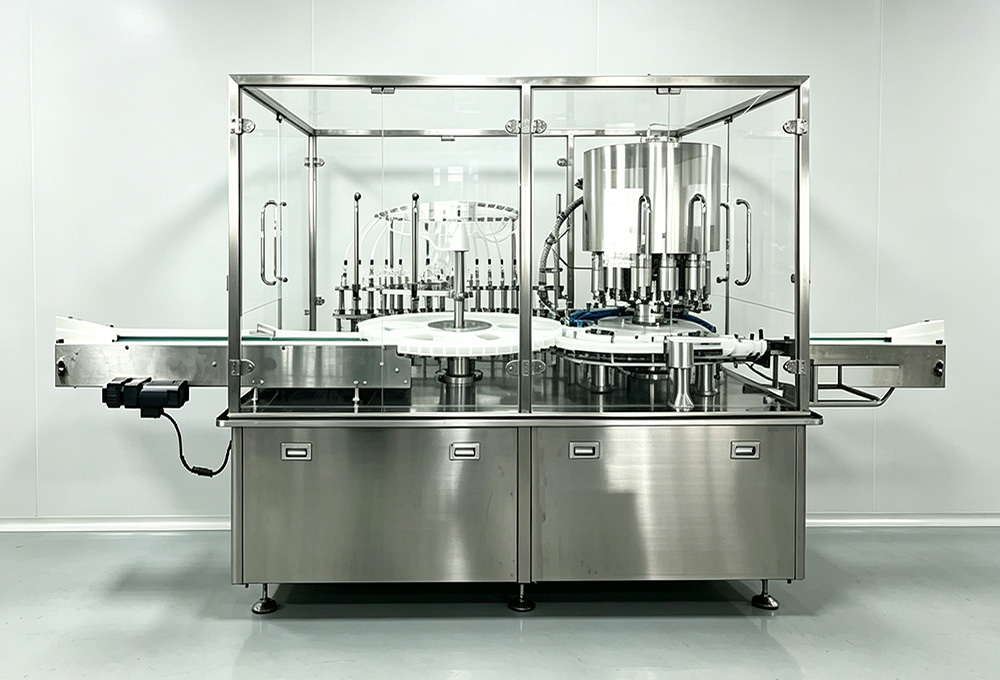
For medicine, compliance shows in the corners. A GMP-friendly machine has smooth welds, no flat ledges that trap dust, no exposed screws inside the product zone, and surfaces that wipe down in minutes. Walk around a proposed line in your mind: where would residue collect? If you cannot clean it in a morning, auditors will notice it too.
Ask for the documentation package before paying a deposit: material certificates, CE or local declarations, operation and maintenance manuals, layout drawings, and validation support for IQ, OQ, and PQ if your market requires it. Paperwork delays an audit far more than the machine itself does.
Export buyers should raise standards early. Voltage, hygiene design, and certification differ by region. Retrofitting after delivery costs several times more than building it correctly in the first place.
Look for sealed motors, drainable hoppers, and CIP-friendly piping. These details separate a medicine machine from a beverage machine that merely looks stainless.
Understand the Real Price Ranges
Price swings with automation, speed, cleanliness level, and materials. Treat these as rough guides, not fixed numbers.
A small semi-automatic filler capper labeler combo for startup labs and trial batches usually runs about $5,000 to $20,000. It works, but operators still load and inspect by hand.
A fully automatic medium-speed line for syrup, oral liquid, and small glass or plastic bottles commonly sits at $30,000 to $80,000. That covers filler, capper, labeler, coder, and basic conveyor together.
A high-speed GMP or aseptic vial line with washing, sterilization, closed filling, and vision inspection can reach $100,000 to $300,000 and above. Most of that cost lives in cleanroom integration and validation, not the metal.
Buy modules separately and expect roughly $10,000 to $40,000 for an automatic filler, $5,000 to $20,000 for a capper, and $3,000 to $15,000 for a labeler. Here is the hidden truth: two quotes in the same range can differ a lot because of servo versus stepper drives, 316L versus 304 steel, and whether conveyors, spares, shipping, installation, and training are included. Always ask for an all-inclusive number.
Plan the Floor Space, Utilities, and Layout
A long straight line looks great on a brochure. It may not fit your building. Before you choose length, measure the room, the door width, the elevator, and the path the machine takes inside. Designing a bottle packaging line around your existing space beats forcing your space around the machine.
Check utilities early. Most automatic lines need compressed air around 0.6 to 0.8 MPa, three-phase power matching local voltage, and sometimes clean water for CIP. Missing one stops commissioning for weeks while you source it.
Leave real working room. Every panel and every module should open from one side. A line wedged against a wall looks tidy until a seal breaks and nobody can reach it.
Ask the supplier for a dimensioned layout drawing before ordering, and compare it against your floor plan yourself. Do not trust a vague photo.

Ask the Right Questions Before You Order
When I compare quotes now, I skip the glossy cover first. I look for proof: a video of the machine running your exact bottle and product, or a trial at the supplier workshop with your own sample liquid. Fill accuracy, cap torque, and label alignment look perfect on water and fail on real syrup.
Check pharma track record. A factory that mostly packages beverages can copy a stainless exterior but miss the hygiene habits auditors inspect. Ask how many pharma lines shipped in the past two years and request reference customers in your region.
Get warranty in writing. Typical coverage runs twelve to eighteen months. You need to know which parts are covered, what counts as misuse, and how fast spares ship. Ask lead time too, because custom star wheels and feeder bowls add weeks beyond the standard build.
And do not mix modules from random brands unless the supplier guarantees the connection. Different speeds, heights, and signals rarely speak the same language.
After-Sales Support and Long-Term Running
Delivery is not the finish line. On site installation, operator training, and commissioning decide how quickly you reach full output. Find out whether an engineer travels, whether remote video support is real or just a phone number, and how many days training takes.
Keep spare parts thinking long-term. Seals, springs, belts, and label sensors wear out. Confirm which items the factory stocks and how quickly they ship, then keep the recommended list in your maintenance file from day one.
Plan maintenance on a schedule: recalibrate fill volume, check cap torque, verify label alignment, and log cleaning cycles even when everything runs well. Stable records protect both output and your GMP file.
Mic Machinery backs its lines with installation assistance, operator training, ongoing technical support, and spare parts access, so production keeps running instead of waiting on a reply from overseas.
The safest buy is rarely the cheapest quote. It is the line that matches your real output, handles your actual liquid, satisfies GMP in both design and paperwork, fits your room, and comes from a supplier who answers after the deposit. Bring your bottle samples, your viscosity data, and this list of questions to every meeting. You will walk away with a line that runs for years instead of an expensive bottleneck.
FAQ
1.What does a pharma bottle packaging machine actually cost?
A small semi automatic combo runs about $5,000 to $20,000, a full automatic medium speed line about $30,000 to $80,000, and a high speed aseptic GMP vial line about $100,000 to $300,000 or more. Speed, materials, validation, and included modules set the final number.
2. Can I buy modules from different brands and connect them myself?
Usually not worth it. Different speeds, conveyor heights, and control signals rarely match cleanly, and no single supplier takes responsibility for the joint. Buy the line from one supplier or get a written connection guarantee.
3. How many bottles per minute do I really need?
Take your daily output, divide by working hours, add a twenty percent buffer for changeovers and jams. Do not buy for your best single day; buy for your average day.
4. What proof should I ask for before paying the deposit?
A video or workshop trial running your own bottle and product, material certificates, warranty terms in writing, a dimensioned layout, and reference customers with pharma experience.
5. Does a cheaper line always fail GMP audit?
Not always, but it often hides savings in 304 instead of 316L steel, weak documentation, and hard to clean corners. Ask where the savings come from before you assume it passed.
6. How long until the line is up and running?
Standard modular lines commonly ship within thirty to sixty days, custom tooling and aseptic lines take longer. Installation and training take several days to two weeks, depending on complexity.