
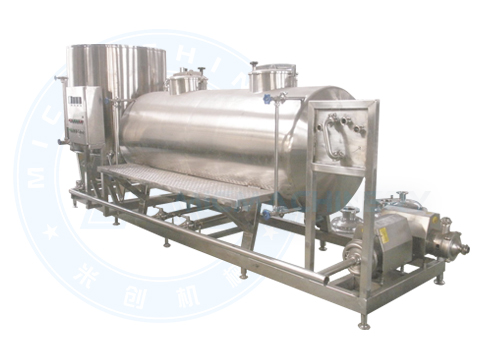
Cleaning In Place
Cleaning in Place
Cleaning in Place (CIP) is a system designed to clean equipment without disassembly or relocation. This equipment is applicable to the industrial production of virtually all liquid products, including beverages, dairy products, oral liquids, and alcoholic beverages. CIP involves using high-temperature cleaning solutions of specific concentrations to vigorously clean the inner surfaces of production equipment—such as material pipelines, pump chambers, valve bodies, tank interiors, and heat exchangers—without dismantling or moving the apparatus, ensuring thorough cleaning of all surfaces that come into contact with the product.
Mechanism of Action
The primary mechanism of action for CIP cleaning relies on the chemical energy generated by the added cleaning agents, which is the most critical factor determining cleaning efficacy.
Manufacturers typically select detergents based on the nature and severity of contamination, material composition, water quality, chosen cleaning method, cost, and safety considerations. Common detergents include acidic, alkaline, and sterilizing cleaners.
Acid washing (1%-2% nitric acid solution) removes residues like calcium salts and mineral oils through chemical reactions;
Alkaline washing (1%-3% sodium hydroxide) eliminates residues such as fats and proteins via saponification reactions.
Sterilizing detergents (chlorine-based disinfectants) are effective against all microorganisms; When diluted, they are generally non-toxic and form a protective film on equipment surfaces to eliminate odors.
At a given flow rate, higher temperatures reduce the viscosity coefficient of thermal energy. Elevated temperatures typically alter the physical state of contaminants, accelerate chemical reaction rates, and increase the solubility of contaminants. This facilitates the detachment of impurity solutions during cleaning, thereby enhancing cleaning effectiveness and reducing cleaning time.
Principles and Components
In-situ cleaning refers to the process of thoroughly cleaning the inner surfaces of production equipment—including material pipelines, pump chambers, valve bodies, tank interiors, and heat exchangers—using high-temperature cleaning solutions of specific concentrations, without disassembling or relocating the equipment. This system primarily comprises hot water tanks, acid tanks, alkali tanks, process pumps, return pumps, piping systems, heating systems, and electrical control systems. Tank capacities (typically 100L, 500L, 1000L, 2000L, 3000L, etc.), heating methods (steam or electric heating), equipment materials (304 or 316 stainless steel), and control modes (Manual Control: Manual operation of a few valves and electrical switches; Semi-Automatic Control: Automatic control of heating temperature, tank liquid levels, and main valves; Fully automatic control: Touchscreen + PLC system covering heating temperature, tank liquid levels, valves, automatic chemical dosing, automatic cleaning programs, etc.) are all customizable.
Key Features of Cleaning In Place Systems
- Automated Operation – A CIP On-Site Cleaning System is programmable, performing cleaning cycles without manual intervention, which reduces labor costs and human errors.
- High Cleaning Efficiency – Optimized flow rates, temperature, and chemical dosing ensure complete sanitization of even complex piping networks.
- Time-Saving Design – As an On-site Cleaning System, CIP eliminates the need to disassemble equipment, significantly reducing downtime.
- Reliable and Consistent – Continuous monitoring of flow, temperature, and chemical concentration guarantees uniform results every cycle.
- Durable Construction – Most systems are made of SUS304 or SUS316 stainless steel, offering corrosion resistance and long-term service life.
Advantages of CIP On-Site Cleaning Systems
- Enhanced Hygiene and Safety – Maintains strict cleanliness standards, preventing contamination in food, beverage, and pharmaceutical production.
- Cost-Effective Operation – Reduces water, energy, and cleaning chemical consumption while lowering labor requirements.
- Environmentally Friendly – Optimized cleaning cycles minimize waste and chemical discharge.
- Flexible and Scalable – Suitable for production lines of all sizes, easily adapting to changing operational needs.
- Improved Production Efficiency – Quick cleaning cycles allow faster equipment turnaround, increasing overall productivity.
Please feel free to let us know if you need any help, we will provide a professional guidance for you! Contact Us